


At 17-23, the 2026 Red Sox Need What the ’80s Sox Had: The Fear Factor

There’s something fitting about this version of the Boston Red Sox sitting at 17-23 after another frustrating series against the Tampa Bay Rays. Not because the record is acceptable — it isn’t — but because six weeks into a baseball season is exactly when emotions start lying to you.
Every loss feels permanent. Every cold streak feels fatal. Every sloppy inning becomes proof that the season is cooked.
And yet… baseball has never worked that way.
Six weeks is enough time to expose flaws. It is not enough time to define a team forever.
Maybe this Red Sox club finds itself sometime in June and makes a legitimate run. Maybe the pitching stabilizes, the lineup catches fire, and suddenly everyone forgets what May felt like.
Or maybe this thing completely unravels.
At this point? Your guess is as good as mine.
So instead of pretending we know exactly where the 2026 Red Sox are headed, maybe it’s worth taking a short break from the daily frustration machine and looking back at a different era. Back to a time when Fenway Park felt intimidating every single night. Back to a time when the outfield alone could beat you.
Because for a stretch in the 1980s, the Red Sox rolled out an outfield that terrified the American League.
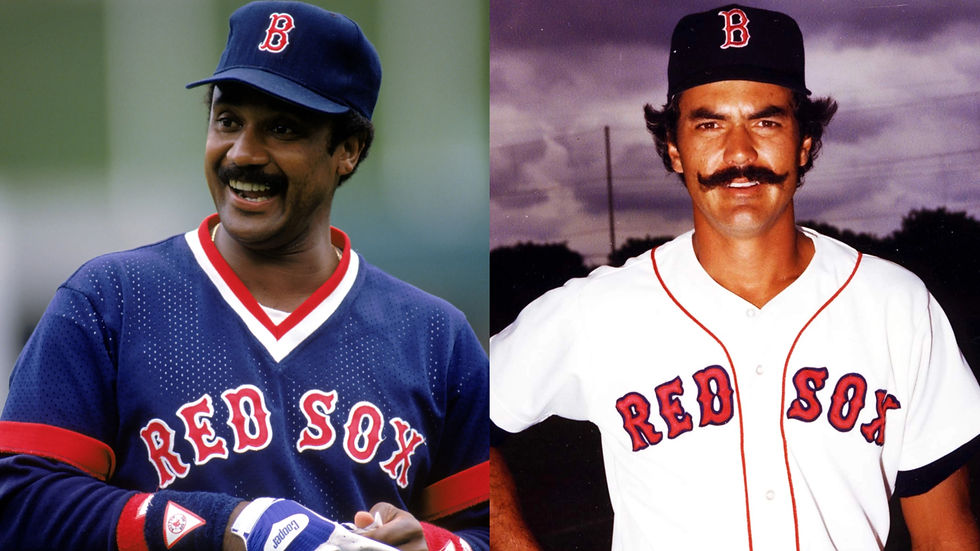
Jim Rice in left field.Tony Armas in center.Dwight Evans in right.
Three completely different players. Three completely different personalities. One absolute nightmare for opposing pitchers.
And even now, decades later, they remain one of the most underrated outfields baseball has ever seen.
Jim Rice looked like baseball’s version of a heavyweight boxer.
Everything about him felt intimidating. The stance. The silence. The way he carried himself walking to the plate. Fenway Park used to buzz differently when Rice came up with runners on base because everyone in the building knew the ball might leave the stadium in a hurry.
Rice didn’t just hit home runs. Plenty of guys hit home runs.
Rice hit baseballs violently.
Line drives turned into missiles. Pitchers made mistakes and watched them disappear into the Monster Seats before they even fully turned around. There are still stories from pitchers from that era talking about how loud contact sounded off Rice’s bat compared to almost anybody else.
And it wasn’t just raw power.
That’s the thing younger fans sometimes miss when they hear older generations talk about Jim Rice. He wasn’t some all-or-nothing slugger. Rice could hit for average. He could drive the ball to all fields. He could punish lefties and righties alike. During his peak years, there were seasons where he genuinely felt unavoidable.
The 1978 MVP season still lives in Red Sox history for a reason. But even beyond the awards and numbers, Rice became an identity for the franchise. Opponents feared him because he represented pressure. One mistake could ruin your entire night.
Then there was Dwight Evans.
If Rice was intimidation, Evans was precision.
To this day, Dwight Evans might still somehow be underrated nationally despite Red Sox fans knowing exactly how special he was. The man did everything. Gold Glove defense. Massive power. Elite plate discipline before baseball fully appreciated on-base percentage. One of the best throwing arms Fenway Park has ever seen.
Right field at Fenway isn’t easy, and Evans made it look effortless.
Runners stopped taking extra bases because they respected his arm too much. There were games where opponents practically played scared once the ball was hit toward right field. And offensively, Evans evolved beautifully as he aged. Early in his career he was a talented player with flashes of greatness. Later, he became one of the smartest hitters in baseball.
He worked counts. He wore pitchers down. He hit huge home runs in huge moments.
And unlike Rice, who carried an almost mythical aura of danger, Evans felt cold-blooded and methodical. Like a player who was always one step ahead of you.
He was the kind of player managers dream about because he impacted winning even when he wasn’t hitting bombs.
Then came Tony Armas.
Armas sometimes gets overlooked in conversations about that outfield because Rice and Evans became such towering Red Sox figures, but for a few years, Armas brought an electricity to center field that changed games instantly.
He played with aggression.
Everything looked explosive. The swing. The routes in the outfield. The arm strength. The energy. He wasn’t graceful in the traditional sense — he played like somebody trying to break the game open every inning.
And when healthy, he absolutely could.
Armas led the league in home runs and RBIs in 1984 and gave the Red Sox a true power threat in center field, which was rare at the time. Most teams were happy if their center fielder could simply run and defend. Armas could hit balls into the night while still tracking down drives in the gaps.
That combination mattered.
Rice punished you. Evans outsmarted you. Armas overwhelmed you.
Together, they created a defensive and offensive presence that changed how opponents approached the Red Sox entirely.
Think about what opposing teams saw walking into Fenway.
You couldn’t relax against Rice because he could end the game with one swing.
You couldn’t challenge Evans carelessly because he’d work a count and destroy mistakes.
And if you managed to survive both, Armas could still ambush you with power from the middle of the field.
Defensively, it wasn’t any easier.
Evans had arguably the best arm of the three. Rice was stronger defensively than people remember, especially early in his career. And Armas covered ground in center with a fearless style that energized the entire ballpark.
There was swagger to that outfield.
Not manufactured swagger like today’s social media versions of confidence. Real swagger. The kind built through intimidation and consistency. Opposing teams genuinely respected them because they knew Boston’s outfield could control games in multiple ways.
And honestly? That’s part of what makes this current Red Sox season feel frustrating to older fans.
The 2026 team has talent. Nobody denies that.
There are young pieces worth believing in. There are stretches where the offense suddenly looks dangerous again. There are nights where Fenway feels alive for three innings and you convince yourself they’re about to turn the corner.
Then the bullpen melts down. Or the defense collapses. Or the bats disappear for two straight games.
That consistency — that fear factor — simply isn’t there right now.
Back in the 1980s, opponents knew exactly what Boston’s identity was.
Power. Toughness. Pressure.
The current Red Sox still feel like they’re searching for theirs.
And maybe they’ll find it.
That’s the funny thing about baseball seasons. They can pivot fast. A hot two-week stretch changes standings quickly. One young player catching fire can energize an entire clubhouse. One rotation stabilizing can suddenly make a flawed roster dangerous.
We’ve seen stranger turnarounds than this before.
But if this team wants to climb out of the mess they’ve created at 17-23, they need something the Rice-Armas-Evans teams always had:
Presence.
Not hype. Not potential. Presence.
The kind that makes opponents uncomfortable before first pitch even starts.
Because the great Red Sox teams — even the imperfect ones — always had players you feared.
Jim Rice was feared.
Dwight Evans was respected like a surgeon with a bat and a cannon for an arm.
Tony Armas brought chaos every single night.
Together, they gave Boston something every contender needs: identity.
Right now, six weeks into 2026, the Red Sox are still trying to figure out theirs.
Maybe they do.
Maybe they don’t.
But until they prove otherwise, it’s hard not to look back at those 1980s teams and remember what real baseball intimidation looked like at Fenway Park.
WRITTEN BY: TIM HOURIHAN
If you're interested in being notified when the next article comes out, be sure to scroll down to the "Free Subscription" form and subscribe, we hope you enjoyed!


Comments